California Right-of-Way Rules: Who Goes First, and Who Waits
California right of way rules for four-way stops, uncontrolled intersections, left turns, roundabouts, crosswalks, bike lanes and sirens, with the Vehicle Code behind each one.
 Stallion School of Driving instructors · Chico, CAUPDATED · OCT 3, 2026 · CHECKED AGAINST CA DMV SOURCES OCT 4, 2026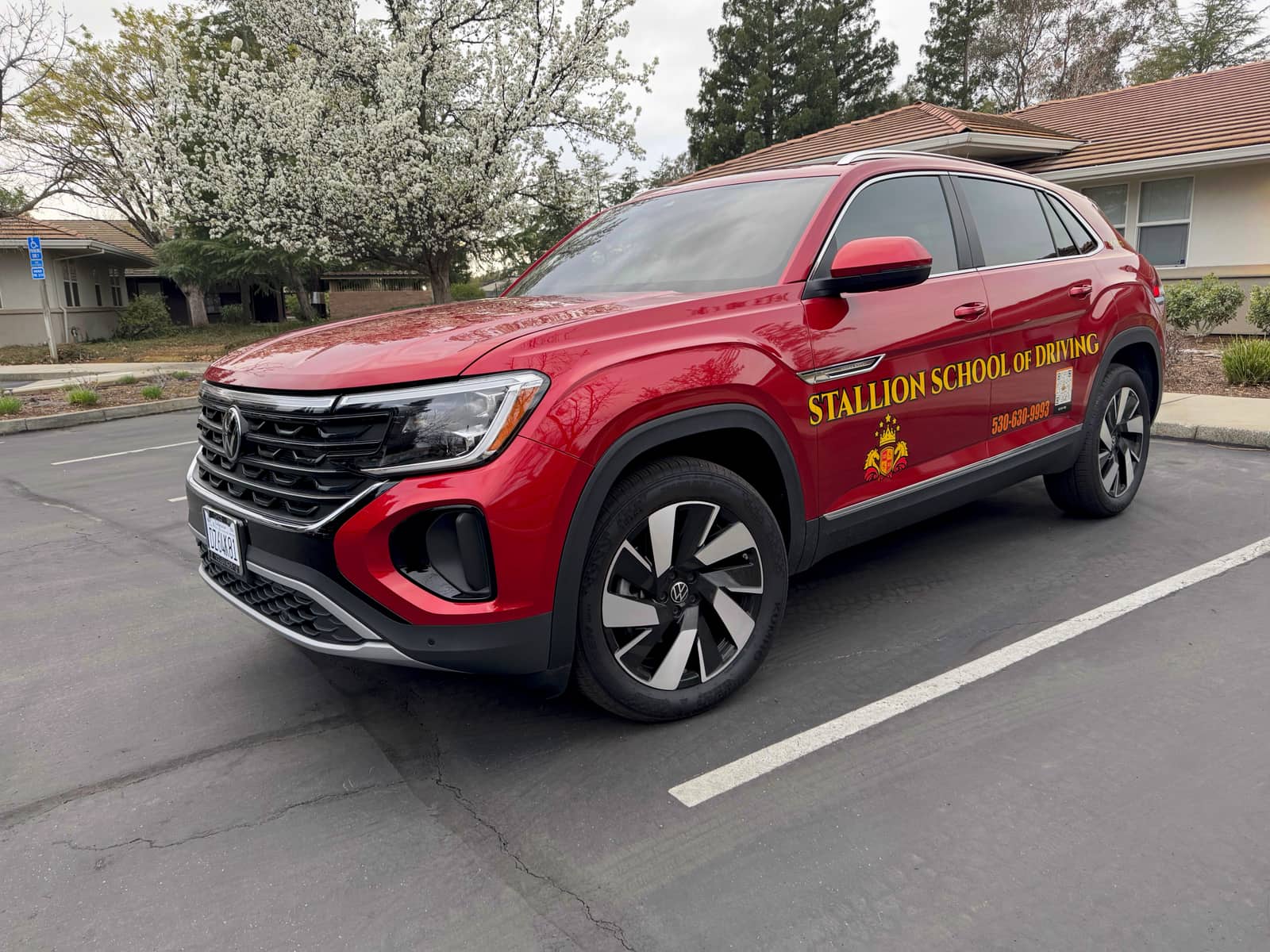
California right of way rules come down to a few plain ideas. At a four-way stop, the first car to stop goes first, and when two cars arrive at the same time, the driver on the left yields to the car on the right. At an uncontrolled T-intersection, traffic on the through road goes first, a driver turning left waits for oncoming traffic, and pedestrians have the right-of-way in every marked or unmarked crosswalk. The rules say who must yield. They never give anyone permission to force a collision.
California right-of-way rules at a glance
The DMV handbook says never assume other drivers will give you the right-of-way, and give up your right-of-way when it will help prevent a collision. Here is who goes first, and the rule behind each answer.
| Situation | Who goes first | Where the rule comes from |
|---|---|---|
| Four-way (all-way) stop | The first car to stop. If two stop at the same time, the car on the right | Handbook Section 7; CVC 21800(c) |
| No signs at all (uncontrolled) | The car already in the intersection. Arriving together, the car on the right | CVC 21800(a) and (b) |
| T-intersection, no signs | Traffic on the through road | CVC 21800(b); Handbook Section 7 |
| You turn left, a car comes straight at you | The oncoming car, if it is close enough to be a hazard | CVC 21801 |
| Stop sign only on your street | Cross traffic. You stop, then wait for a safe gap | CVC 21802 |
| Leaving a driveway, alley or parking lot | Traffic already on the road | CVC 21804 |
| Roundabout | Traffic already in the circle | Handbook Section 7 |
| Person in a crosswalk, marked or not | The pedestrian | CVC 21950 |
| Siren and red light approaching | The emergency vehicle. Pull right and stop | CVC 21806 |
| Traffic light not working | Treat it as an all-way stop | CVC 21800(d); Handbook Section 7 |
Who goes first at a 4-way stop in California?
Every driver makes a full stop at the limit line, or before the crosswalk or intersection if there is no line. Then the vehicle that arrived first goes first. Vehicle Code 21800(c) settles the tie: when two vehicles enter an all-way stop at the same time, the driver on the left yields to the vehicle on the immediate right.
The yield-to-the-right rule does not apply when two cars face each other and one is turning left. The left-turning driver yields to the car coming straight through (CVC 21800(e) and 21801).
When it is truly unclear who was first, make eye contact and let the other driver go. On the drive test, the DMV scores whether you start "without causing confusion or impeding traffic flow", so aim for a clear, predictable start. Waving everyone through when it is your turn confuses people too.
Picture a lesson on quiet residential streets near Bidwell Park. The student stops, sees a white car already stopped across the intersection, and says out loud: "White car was first. Then me." That one sentence shows the instructor the student saw the car and ranked the order.
What is an uncontrolled intersection in California?
An uncontrolled intersection has no stop signs, yield signs or signals. There, Vehicle Code 21800 applies: yield to any vehicle that has already entered the intersection from a different road. If you arrive at the same time, yield to the vehicle on your right.
At a T-intersection, the rule changes. The handbook says vehicles, bicyclists and pedestrians on the through road have the right-of-way. If your street ends at the T, you yield, even if the other car is on your left.
The handbook calls an intersection blind if there are no stop signs at any corner. When hedges or parked cars block your view, move forward slowly until you can see. The speed limit at a blind intersection is 15 mph.
On test day, the DMV's DPE scoring criteria list it as a Critical Driving Error when you "do not move your head and eyes to make a traffic check at an uncontrolled intersection when a hazard is present."
Who has the right-of-way when you turn left?
The car going straight. Vehicle Code 21801 says a driver turning left, or making a U-turn, yields to oncoming vehicles close enough to be a hazard, and keeps yielding until the turn can be made with reasonable safety. A green light or a flashing yellow arrow does not change this: you still yield to oncoming traffic and to anyone already in the intersection.
Two habits help. Keep your wheels straight while you wait, so a bump from behind cannot push you into oncoming traffic. And do not trust an oncoming car's right signal. The handbook warns the driver may have it on by mistake. Wait until the car actually starts its turn.
Stop signs on only some corners, yield signs and driveways
At a two-way stop, you stop, then yield to traffic on the other road that is close enough to be an immediate hazard (CVC 21802). At a yield sign, slow down, ready to stop, and give way to any vehicle, bicyclist or pedestrian (CVC 21803).
Leaving a driveway, an alley or a parking lot, you yield to all traffic on the road (CVC 21804). Before you cross a sidewalk to get there, you yield to anyone walking on it (CVC 21952).
How do roundabouts work?
The handbook steps: slow down, yield to all traffic already in the roundabout, and enter to the right when the gap is big enough. Travel counter-clockwise, do not stop or pass inside, signal to change lanes or exit, and if you miss your exit, go around again. In a two-lane roundabout, choose your lane by destination: the right lane to turn right, either lane to go straight, and stay in the roundabout until you reach your exit to turn left. Paradise has roundabouts in the town center, so our Paradise lessons include them.
Pedestrian right-of-way in California
Vehicle Code 21950 says a driver must yield to a pedestrian crossing within any marked crosswalk or any unmarked crosswalk at an intersection. As the handbook puts it, "Not all crosswalks are marked." When there is a limit line before the crosswalk, stop at the line.
A pedestrian crossing away from a crosswalk must yield to close traffic (CVC 21954), but the same section keeps the driver's duty of due care, and the handbook tells you to slow down or stop so the person can finish crossing. Three rules new drivers forget:
- Never pass a car stopped at a crosswalk. It may be stopped for someone you cannot see (CVC 21951).
- A flashing "Don't Walk" still means yield. The handbook says drivers must yield to pedestrians even when the signal is flashing.
- Do not stop in the crosswalk. It forces people to walk around your car into traffic.
A pedestrian who is blind or partly blind, using a white cane or a guide dog, has the right-of-way at all times. Under Vehicle Code 21963, failing to yield to them is a misdemeanor, with a fine of $500 to $1,000, up to six months in county jail, or both. Do not honk, take extra care in a quiet hybrid or electric car, and when the person pulls in their cane and steps back, that usually means you may go. Around downtown Chico and CSU Chico, students practice with pedestrians and cyclists on every block. People step out between parked cars, so we slow early and scan the sidewalks, not only the road.
Do you have to yield to bicycles?
Yes, often. Bicyclists have the same rights and responsibilities as other drivers. When you pass a bicycle going your way, the Three Feet for Safety Act (CVC 21760) requires at least three feet of space. If another lane is available, change lanes to pass. If you cannot give three feet, slow down and wait.
Turning right across a bike lane has its own rule. To turn, you enter the bike lane within 200 feet of the intersection (CVC 21209). Check over your right shoulder, merge in behind any bicyclist, then turn. Skipping the shoulder check on a right turn with a bike lane is a Critical Driving Error on the test. The steps are in our guide to California turn and U-turn rules.
Emergency vehicles and merging
When an emergency vehicle comes with a siren and a red light, Vehicle Code 21806 requires you to yield, drive to the right edge of the road clear of any intersection, and stop until it has passed. If you are already in the intersection, keep going and pull right as soon as it is safe. Do not follow within 300 feet of an emergency vehicle using its siren or lights.
When merging, the handbook says highway traffic has the right-of-way and a driver entering traffic yields to cars already in the lanes. Never enter an intersection you cannot clear before the light turns red. Our Highway 99 merging guide covers on-ramps step by step.
How we teach it
Right-of-way is a seeing skill before it is a rule. In the teen 6-hour training, lesson 2 adds traffic, lane changes, intersections and right-of-way. We use the habits on our teaching method page:
- Commentary driving. At every stop, the student says the order out loud: who was first, who is next, who is in the crosswalk.
- Eyes far ahead. Eyes 12 to 15 seconds down the road, so the stop sign, the pedestrian and the cyclist are seen early.
- Mirror, signal, shoulder, go. Before every turn across a bike lane.
- Calm correction. One short sentence about what happened, then another try at the next corner.
Downtown and CSU Chico come after the quiet streets, once stops and turns are steady. Orland's downtown grid of four-way stops and the town center in Durham give the same practice in those towns. To see how examiners score all of this, read what the DMV drive test checks.
Quick answers
Who goes first at a 4-way stop in California? The first car to stop. If two cars stop at the same time, the driver on the left yields to the car on the right.
Who has the right-of-way at an uncontrolled T-intersection? Traffic on the through road. If your street ends at the T, you yield.
Do pedestrians always have the right-of-way in California? Drivers must yield to pedestrians in any marked or unmarked crosswalk, and must still use due care for a pedestrian crossing anywhere else.
How much room do you give a bicycle when passing? At least three feet. If you cannot give three feet, slow down and wait until you can pass safely.
Sources
- Section 7: Laws and Rules of the Road - California DMV
- Section 7: Laws and Rules of the Road (Continued) - California DMV
- Section 6: Navigating the Roads - California DMV
- Driving Performance Evaluation (DPE) Scoring Criteria - California DMV
- California Code, VEH 21800
- California Code, VEH 21801
- California Code, VEH 21802
- California Code, VEH 21803
- California Code, VEH 21804
- California Code, VEH 21952
- California Code, VEH 21954
- California Code, VEH 21451
- California Code, VEH 21950
- California Code, VEH 21951
- California Code, VEH 21963
- California Code, VEH 21760
- California Code, VEH 21806
- California Code, VEH 21209