Is It Legal to Make a U-Turn in California? Turn and Lane Rules
Is it legal to make a U-turn in California? Where it is and is not, right and left on red, the 100-foot signal, bike lanes, the 200-foot center lane limit, and drive test scoring.
 Stallion School of Driving instructors · Chico, CAUPDATED · OCT 3, 2026 · CHECKED AGAINST CA DMV SOURCES OCT 4, 2026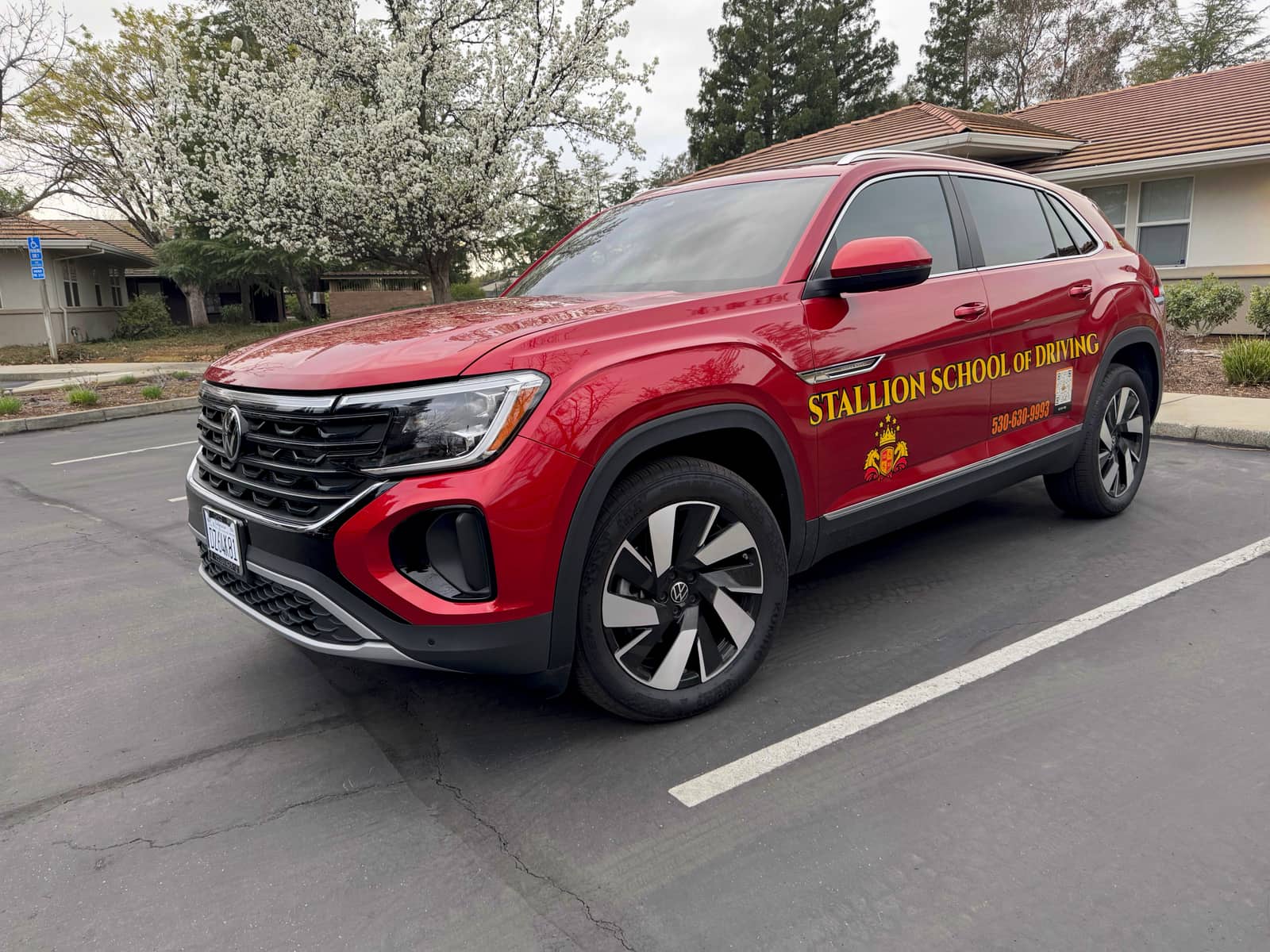
Is it legal to make a U-turn in California? Yes, in many places: at an intersection on a green light unless a NO U-TURN sign is posted, across a double yellow line, and in a residential district when no vehicle is approaching within 200 feet. It is illegal in a business district except at an intersection or a divided-highway opening, on a one-way street, at a railroad crossing, in front of a fire station, and anywhere you cannot see 200 feet in both directions. Right on red is legal after a full stop unless a sign says otherwise.
Is it legal to make a U-turn in California? Where yes, where no
The DMV handbook lists where a U-turn is allowed and where it never is. The Vehicle Code adds the details.
| U-turn | Legal? | The rule |
|---|---|---|
| At an intersection on a green light or left green arrow, no sign | Yes, from the far-left lane | CVC 21451, 22100.5 |
| Across a single set of double yellow lines | Yes, under the U-turn rules | CVC 21460(d) |
| Residential district, no vehicle approaching within 200 feet | Yes | CVC 22103 |
| Divided highway, at an opening in the divider | Yes | Handbook Section 6 |
| Business district, away from an intersection | No | CVC 22102 |
| Where a NO U-TURN sign is posted | No | Handbook Section 6 |
| Where you cannot see 200 feet in both directions | No | CVC 22105 |
| In front of a fire station, or using its driveway | No | CVC 22104 |
| On a one-way street or at a railroad crossing | No | Handbook Section 6 |
| Over a divider, curb or two sets of double yellow lines | No | Handbook Section 6 |
Two terms decide many cases. In a business district, where most offices and businesses are, a U-turn is allowed only at an intersection or a divided-highway opening. In a residence district, Vehicle Code 22103 forbids a U-turn when any vehicle is approaching from either direction within 200 feet, except at an intersection where a traffic signal or sign controls that approaching car. How to make one: signal, move into the left turn lane or far-left lane, yield to oncoming traffic until the turn is reasonably safe (CVC 21801), and look in all directions before and during the turn. The DMV's teen tips suggest practicing on a wide, quiet residential street, never in heavy traffic.
California U-turn rules at traffic lights
Vehicle Code 21451 says a driver facing a circular green light may go straight, turn, or make a U-turn unless a sign prohibits it. A driver facing a left green arrow may also make a U-turn unless prohibited by a sign. Either way, yield to traffic and pedestrians in the intersection or crosswalk. Vehicle Code 22100.5 adds that a U-turn at a signal-controlled intersection must start from the far left-hand lane available to you.
Is right turn on red legal in California?
Yes. Under Vehicle Code 21453(b), after a full stop at a steady red light, you may turn right unless a sign prohibits it. Then yield to pedestrians in the crosswalk and to any vehicle close enough to be a hazard, and turn when it is safe.
Two exceptions: you may not turn at a red arrow, and you must obey a NO TURN ON RED sign. A dedicated right turn lane that does not merge into another lane lets you turn without stopping, unless its own light or sign says otherwise. Always yield to pedestrians in the crosswalk (Handbook Section 6).
On the drive test, going faster than a brisk walk (4 mph) through a right turn on red is a Critical Driving Error, and so is stopping at a green light for no reason. Make the stop real, then go.
Can you turn left on red in California?
Only from a one-way street onto another one-way street. Vehicle Code 21453(b) allows it after a full stop, unless a sign prohibits it, with the same duty to yield to pedestrians and close traffic. Start from the far-left lane. Downtown Chico's one-way streets are where our students practice one-way turns.
How to make a right turn
Vehicle Code 22100(a) says both the approach and the turn are made as close as practicable to the right-hand curb or edge of the road. The handbook steps:
- Signal. The law requires the signal during the last 100 feet before the turn (CVC 22108). The DMV's teen tips suggest signaling at least 200 feet before a right turn, and the examiner checks it is on at least 100 feet before the turn.
- Look over your right shoulder for bicycles and motorcycles between you and the curb, and slow down.
- Stop behind the limit line if required, then look left, right, left.
- Turn into the right lane. Do not swing wide into another lane.
- Cancel the signal if it does not cancel itself.
Turning into a bike lane in California
If a bike lane runs beside you, you must move into it before the turn. Vehicle Code 21717 says the driver shall drive into the bicycle lane before turning, and Vehicle Code 21209 allows driving in a bike lane only to prepare for a turn within 200 feet of the intersection, to park where allowed, or to enter or leave the road. So: signal, check over your right shoulder, merge into the bike lane behind any cyclist within 200 feet of the corner, then turn.
On the drive test, driving more than 200 feet in a bike lane and skipping the shoulder check on a right turn with a bike lane are both Critical Driving Errors. The DMV's note: enter the bike lane only after making sure there is no bicycle traffic, then turn. Our right-of-way guide covers yielding to bicycles in more detail.
How to make a left turn
Vehicle Code 22100(b) says you approach a left turn as close as practicable to the left edge of the far-left lane, start turning only after entering the intersection, and end in a lane going your way. The handbook adds the details examiners watch:
- Enter a left turn lane at its opening, without crossing a solid line.
- Signal 100 feet before the turn and look over your left shoulder.
- While you wait, keep your wheels pointed straight. If a car hits you from behind with your wheels turned, you could be pushed into oncoming traffic.
- Yield to oncoming vehicles close enough to be a hazard (CVC 21801). Do not trust an oncoming car's right signal until it actually turns.
- Turning from a two-way street, end in the left lane closest to the middle of the road. On one-way streets with three or more lanes your way, the handbook says you may end in any open lane.
You may cross double yellow lines to turn left at an intersection or into or out of a driveway (CVC 21460(d)). Two sets of double yellow lines two or more feet apart are a barrier, and you may not turn across them except at a marked opening.
How does the two-way left turn lane work in California?
A two-way left turn lane sits in the middle of a two-way street, marked on each side by a solid outer line and a dashed inner line. Under Vehicle Code 21460.5, you may use it only to prepare for or make a left turn, or a legal U-turn, and you may not drive in it for more than 200 feet. Where one exists, you may not turn left from any other lane.
How to use it: look for cars coming toward you in the same lane, signal, check your left blind spot, merge fully into the lane within 200 feet of your turn so you do not block traffic, and turn when it is safe. Driving further than 200 feet in it is a Critical Driving Error on the drive test.
What the drive test scores on turns
The DMV's DPE scoring criteria break each turn into approach, stop and turn. Approaching, you check blind spots, signal at least 100 feet out, brake smoothly and use the correct part of the lane. Stopped, you are behind the limit line with wheels straight for a left. Turning, you yield, steer smoothly, end in the proper lane and cancel the signal.
These turn mistakes are Critical Driving Errors, and any one fails the test:
- Faster than 4 mph through a stop sign, a flashing red light or a right turn on red.
- More than 200 feet in a bike lane or a two-way center left turn lane.
- Going straight from a designated turn lane, turning from a straight-only lane, or turning from the wrong lane.
- No mirror or shoulder check on a right turn with a bike lane.
- Driving in the oncoming lane when there is no need.
The full list is in our guide to what the DMV drive test checks.
How we teach turns
Turns start in lesson 1 of the teen 6-hour training, on quiet residential streets. The most common first-lesson fix is speed: slow down before the turn, look where you want to go, and let the wheel return through your hands. The Esplanade and East Avenue add lane choice, signals and protected turns, and downtown Chico adds one-way streets, pedestrians and cyclists.
Every turn uses the routine on our teaching method page: mirror, signal, shoulder, go. With commentary driving, the student says the plan before the corner: "Signal on, bike lane clear, merging in, wheels straight." Before a test, the DMV exam package drills turns with test-style directions.
Quick answers
Is it legal to make a U-turn in California? Yes in many places, including at a green light with no NO U-TURN sign and in a residential district with no car approaching within 200 feet. Not in a business district away from an intersection, on a one-way street or in front of a fire station.
Can you make a U-turn on a double yellow line in California? Yes, across a single set of double yellow lines. Not across two sets spaced two feet or more apart, except at a marked opening.
Is right turn on red legal in California? Yes, after a full stop, unless a NO TURN ON RED sign is posted or the signal is a red arrow. Yield to pedestrians and close traffic.
How far can you drive in a two-way left turn lane? No more than 200 feet. Going further is also a Critical Driving Error on the drive test.
When do you merge into the bike lane before a right turn? Within 200 feet of the turn, after checking over your right shoulder that no bicycle is there.
Sources
- Section 6: Navigating the Roads - California DMV
- Driving Performance Evaluation (DPE) Scoring Criteria - California DMV
- Teen Driver Tips - California DMV
- California Code, VEH 21451
- California Code, VEH 21801
- California Code, VEH 22100.5
- California Code, VEH 22102
- California Code, VEH 22103
- California Code, VEH 22104
- California Code, VEH 22105
- California Code, VEH 21453
- California Code, VEH 22100
- California Code, VEH 22108
- California Code, VEH 21209
- California Code, VEH 21717
- California Code, VEH 21460.5
- California Code, VEH 21460