California School Bus Stopping Law, Rail Crossings and Farm Equipment
California’s school bus stopping law: stop for flashing red lights from either direction. Plus school zone speed limits, railroad crossings and driving behind farm equipment.
 Stallion School of Driving instructors · Chico, CAUPDATED · OCT 3, 2026 · CHECKED AGAINST CA DMV SOURCES OCT 4, 2026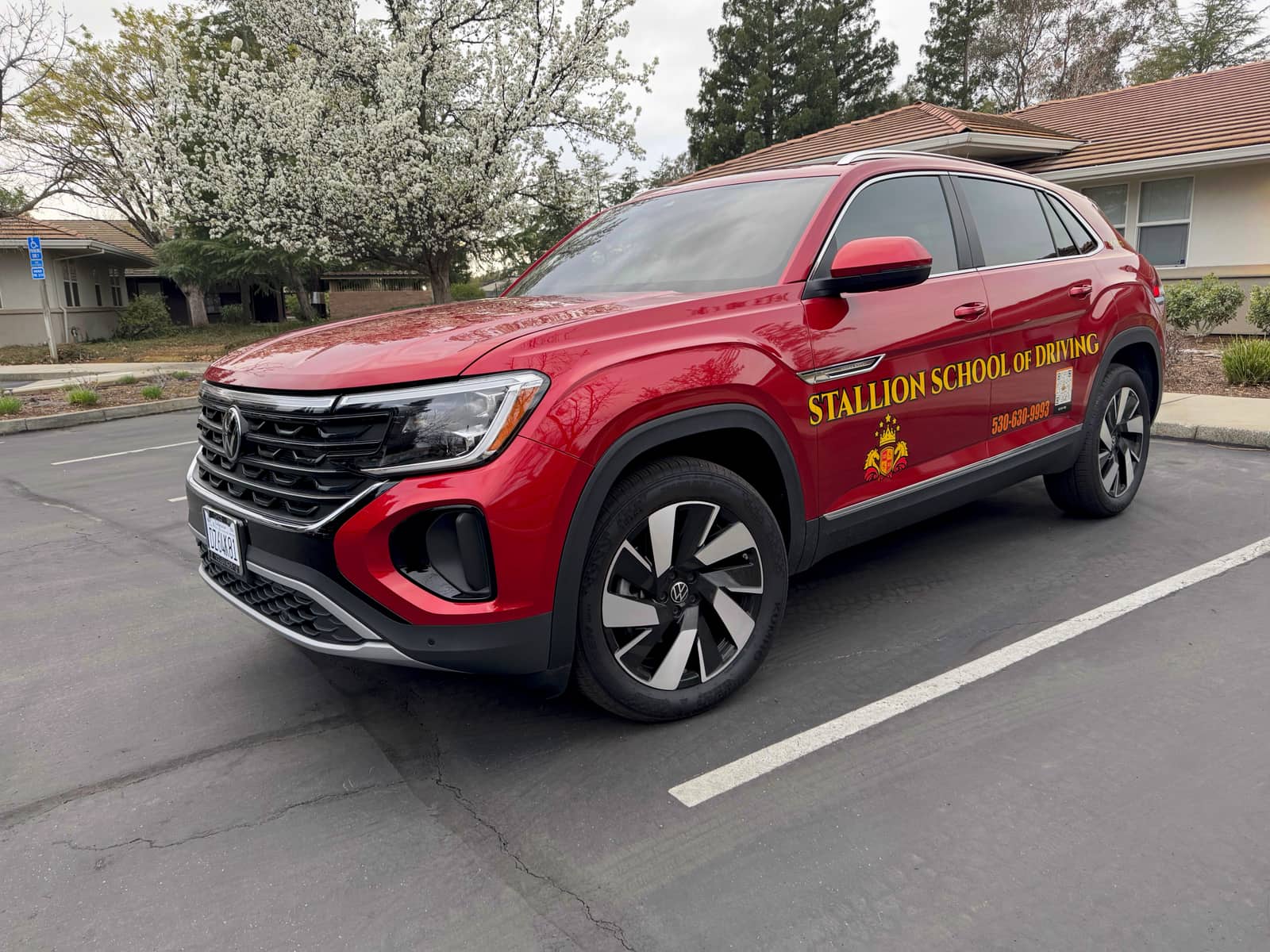
California’s school bus stopping law is simple: when a school bus flashes its red lights, you stop, from either direction, and stay stopped until the red lights stop flashing. The main exception is a bus on the other side of a divided highway, or of a road with two or more lanes in each direction. Passing a school bus with flashing red lights is also a Critical Driving Error that fails the DMV drive test on its own.
School bus stopping law in California
The law is Vehicle Code section 22454. It says a driver meeting or overtaking a school bus "from either direction" that is stopped to load or unload children, with its flashing red light signal and stop arm showing, must stop immediately before passing the bus and stay stopped until the red lights and stop arm stop operating.
The DMV handbook adds what to watch for before the red lights come on. Some buses flash yellow lights when they are preparing to stop. Yellow means slow down and prepare to stop. Red lights, at the top, front and back of the bus, mean stop from either direction until the children are safely across and the lights stop flashing. The handbook also notes that if you fail to stop, you may be fined up to $1,000 and your driving privilege could be suspended for one year.
| Road and bus position | What you do when the red lights flash |
|---|---|
| Two-lane road, bus on your side | Stop |
| Two-lane road, bus on the other side | Stop. Traffic in both directions stops |
| Divided highway, bus on the other side | You do not need to stop |
| Two or more lanes in each direction, bus on the other side | The handbook says you do not need to stop |
| Bus showing flashing yellow lights | Slow down and prepare to stop |
One test-day note. The DMV’s drive test criteria put it a little more strictly: traffic in both directions must stop unless you are on a divided highway. If you are ever unsure what kind of road you are on, stop. A few seconds of waiting costs nothing.
School zone speed limit in California
The handbook sets the school zone speed limit at 25 mph within 500 feet of a school while children are outside or crossing the street, and notes that some school zones post limits as low as 15 mph. Near schools, watch for bicyclists, pedestrians, crossing guards and stopped school buses, and always follow a crossing guard’s directions. A five-sided sign means you are near a school: drive slowly and stop for children in the crosswalk. School crossings may also have yellow crosswalk lines instead of white.
Two more 15 mph limits are worth knowing. At a blind intersection, one with no stop signs at any corner and a blocked view, the limit is 15 mph. In an alley, it is 15 mph too.
Our students practice school zones in Durham’s town center and downtown Gridley, among other places. Teen lessons can also start with a pickup at a high school, so the first minutes of a lesson can be school-zone practice.
Railroad crossing rules in California
A yellow and black round sign, or an X-shaped sign, means a railroad crossing is ahead. The handbook says: look, listen, slow down and prepare to stop, and let any train pass before you go. Many crossings also have a blue and white sign that tells you what to do in an emergency on the tracks or if your car stalls there. Note where that sign is; you may need the number on it.
The handbook sets a 15 mph limit within 100 feet of a crossing where you cannot see the tracks for 400 feet in both directions, unless the crossing has gates, a warning signal or a flagman. At the crossing itself:
- Flashing red lights mean stop and wait. Do not cross until they stop flashing, even if the gate goes up.
- Stop at least 15 feet from the nearest rail when a signal, a flagman or an approaching train warns you. That is Vehicle Code section 22451, which also says no driver may go through, around or under a crossing gate while it is closed.
- Never stop on the tracks. If there is not enough room on the far side to clear the tracks completely, wait before you start across.
- Expect a train on any track, at any time, in either direction. Many crossings have several tracks: look in both directions and cross only when it is safe.
- Gates down but no train? Do not go around them. Call the railroad emergency number posted at the crossing, or 911.
Two other rules tie in: you may never make a U-turn at or on a railroad crossing, and you may not pass another vehicle within 100 feet of one.
Which vehicles must stop at railroad crossings?
Some vehicles stop at every crossing, even with no train in sight, so expect them to stop in front of you. The handbook names buses, school buses and vehicles with hazardous materials placards. Vehicle Code section 22452 also includes farm labor vehicles carrying passengers. Those drivers must stop between 15 and 50 feet from the nearest rail, listen, and look both ways along the track before crossing. A diamond-shaped placard on a truck is the clue that its load may be dangerous and that it will stop.
Keep your three-second gap behind these vehicles near the tracks, and never pass one that is slowing for a crossing.
What to do if your car stalls on the tracks
The handbook gives two plans. If a train is coming or the warning lights are flashing, get out immediately and move away from the tracks at an angle, toward the direction the train is coming from, then call 911. If no train is coming and the lights are not flashing, get out, call the number on the crossing post or the metal control box, give the crossing number if one is posted, say a vehicle is on the tracks, and then call 911.
Driving behind farm equipment
On two-lane rural roads around Durham, Gridley and Biggs, you will share the road with farm equipment. Learn to spot the slow-moving vehicle emblem. Vehicle Code section 24615 requires it on any vehicle built for and driven at 25 mph or less on a public highway: a triangle with the top cut off, a fluorescent orange center and a red reflective border, mounted on the rear between three and five feet off the ground. The handbook describes it as an orange and red triangle and says vehicles with it usually travel at 25 mph or less.
The danger is closing speed. On a two-lane highway where the limit is 55 mph, a driver doing 55 behind equipment moving at 20 is gaining at 35 mph. So the first move is always the same: see the emblem early, ease off, and settle in at a safe following distance.
Pass only when every condition is right. The handbook says pass only where a broken yellow line is on your side, with any hill or curve at least one-third of a mile ahead, not within 100 feet of an intersection, bridge or railroad crossing, and not at crossroads or driveways. On farm roads, watch for field entrances and driveways where equipment may turn. If the equipment is wide, wait for a stretch where the whole oncoming lane is clear. If you see livestock near the road, slow down or stop, and follow directions from the person in charge of the animals.
Waiting is not "too slow." The DMV scores driving 10 mph under the limit as a critical error only when road, traffic or other conditions do not justify the lower speed. A slow vehicle ahead is exactly that kind of condition.
What the DMV drive test scores here
The DMV’s Critical Driving Errors list covers these situations directly. Any one of them fails the test:
- Passing a school bus that has flashing red lights.
- Disobeying traffic safety personnel, a law enforcement officer or a firefighter.
- Driving 10 mph over the limit, which in a 25 mph school zone happens fast.
- Any action that makes another driver or a pedestrian take evasive action, such as a rushed pass around farm equipment.
- Not moving your head and eyes to check traffic at an uncontrolled intersection when a hazard is present.
Our guide to what examiners score covers the full list.
How we teach it
Hazard perception is one of the eight habits in our teaching method, and we teach it with the hazards our area actually has: school zones, parked cars with drivers inside, and farm equipment on rural roads. Students use commentary driving to name them early: "school bus ahead, yellow lights, slowing," or "orange triangle, tractor, stay back." Saying it out loud lets the instructor hear whether the student saw it in time.
Our Gridley and Biggs lessons include county roads with farm equipment, narrow shoulders and railroad crossings, and Durham lessons practice following distance and passing zones on the Midway and the Durham-Dayton Highway. After each lesson, families get written notes, so home practice can repeat the same crossing or stretch of rural road.
Quick answers
Do you have to stop for a school bus on the other side of the road in California? On a two-lane road, yes. You do not need to stop when the bus is on the other side of a divided highway, or of a road with two or more lanes in each direction.
What is the school zone speed limit in California? 25 mph within 500 feet of a school while children are outside or crossing, unless a lower limit, as low as 15 mph, is posted.
How far from railroad tracks do you stop? At least 15 feet from the nearest rail when a signal, flagman or train warns you. Buses, school buses and placarded trucks stop between 15 and 50 feet.
What does the orange triangle on a tractor mean? It is the slow-moving vehicle emblem, used on vehicles built for and driven at 25 mph or less. Slow down early and pass only where it is clearly legal and safe.
Is passing a school bus an automatic fail on the drive test? Yes. Passing a school bus with flashing red lights is a Critical Driving Error in the DMV’s scoring criteria.
Sources
- Section 7: Laws and Rules of the Road (Continued) - California DMV
- Section 7: Laws and Rules of the Road - California DMV
- Section 6: Navigating the Roads - California DMV
- Section 8: Safe Driving (Continued) - California DMV
- Driving Performance Evaluation (DPE) Scoring Criteria - California DMV
- California Code, VEH 22454 - California Legislative Information
- California Code, VEH 22451 - California Legislative Information
- California Code, VEH 22452 - California Legislative Information
- California Code, VEH 24615 - California Legislative Information
- California Code, VEH 22349 - California Legislative Information