How to Choose a Driving School in California: The DMV’s Checklist
The DMV tells parents what to check before choosing a driving school. Here is each point, how to check it with any school, and our own answers, so you can compare fairly.
 Stallion School of Driving instructors · Chico, CAUPDATED · OCT 3, 2026 · CHECKED AGAINST CA DMV SOURCES OCT 4, 2026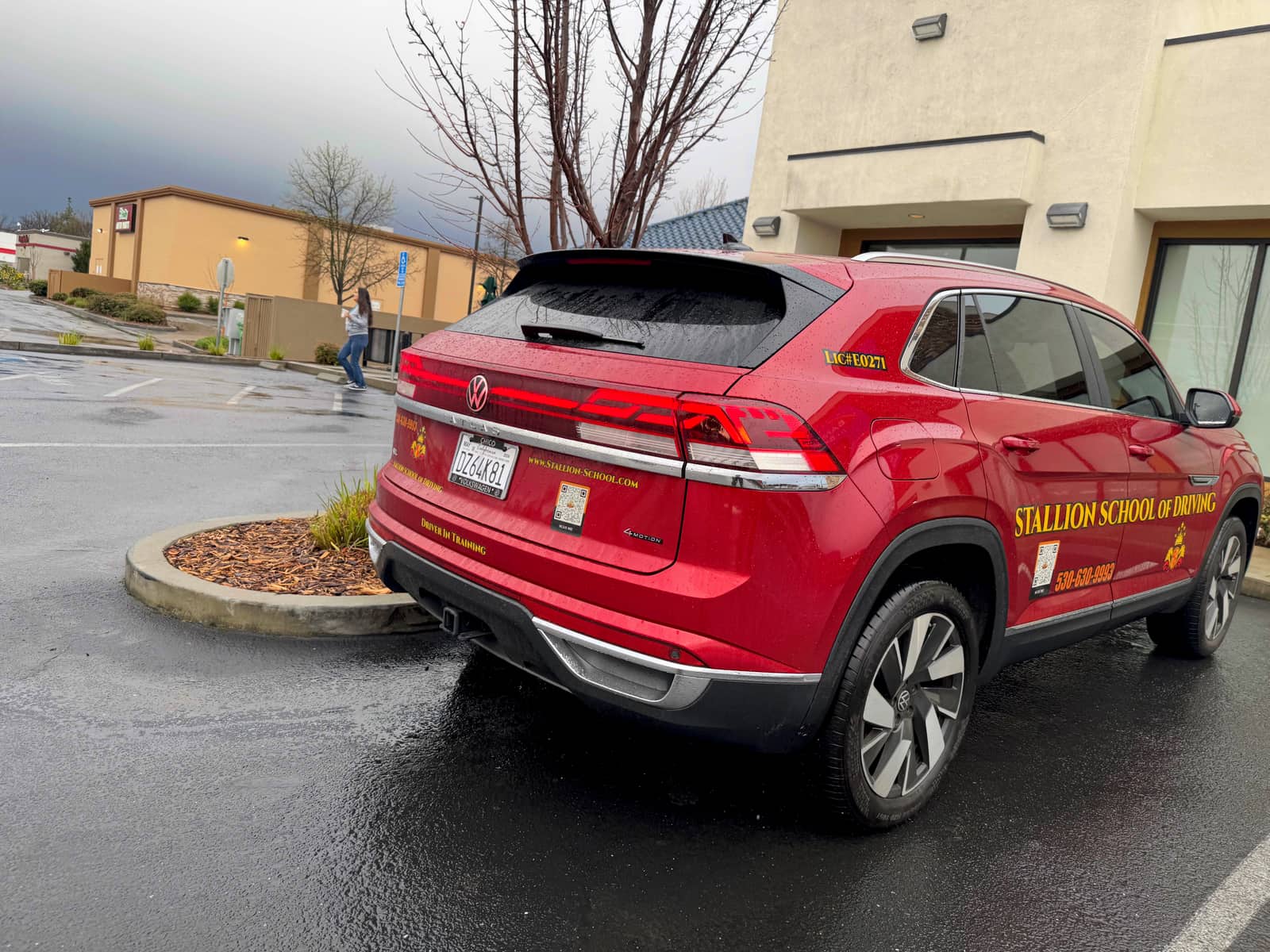
The California DMV publishes its own checklist for choosing a driving school: check the school’s license, look up complaints, compare every fee, keep your receipts, confirm the instructors are licensed, ask about the training cars and the cancellation policy, choose a school in an area you know, and expect no physical contact except in an emergency. Below is each point, how to check it with any school, and how we answer it.
Start with the license
The DMV says a driving school must be licensed and bonded by the DMV, and it gives families a tool to check: the Occupational License Lookup. Choose the Driving School category, then search by business name, city or license number.
Our school license number is E0271, and it is marked on every training car. Look it up yourself rather than taking our word for it. Do the same for every school on your list. It takes two minutes.
The DMV checklist, side by side
The left column is the DMV’s advice. The middle column is how to check it with any school. The right column is our answer, from our published policies.
| DMV point | How to check any school | Stallion’s answer |
|---|---|---|
| Licensed and bonded by the DMV | Search the Occupational License Lookup | License E0271 |
| Check the Better Business Bureau | Search the school at bbb.org; membership is not required | Search us there too. Our Google reviews are public on our Google listing |
| Compare tuition and ask about every fee | Ask for the fee list in writing | Fees are published on our refunds and fees page |
| Keep receipts, contracts and documents | Ask how receipts are given | You accept the Customer Agreement before booking. Payments, including cash, are recorded in your account with a receipt |
| Licensed instructors | Ask to see the instructor ID card; call the DMV at (916) 229-3126 | Every instructor is DMV-licensed and background-checked |
| Instructor foot brake and extra rearview mirror | Ask to see both | Dual-control SUVs with an instructor brake |
| Liability insurance | Ask about the vehicle insurance | Fully insured, with the vehicle insurance required of California driving schools |
| Yearly inspection | Ask when the car was last inspected | Ask us the same question |
| Cars used for instruction only | Ask whether instructors run errands during lessons | Lessons keep to their booked purpose and route. Instructors bring no passengers of their own |
| An emergency phone number | Ask which number to call during a lesson | 530-630-9998. In an emergency, call 911 |
| Cancellation and rescheduling policy | Read it before you pay | Published on our booking policy page |
| A school in an area you know | Ask where lessons start and which roads they use | Pickup at home, school or work in five towns; a set meeting point in Oroville and Gridley–Biggs |
| No physical contact except in an emergency | Ask for the conduct policy | Written into our agreement; details below |
Instructors: licensed, and ask to see the card
The DMV says driving school instructors must be licensed and must pass qualifying exams every three years or show continuing traffic safety education. The DMV handbook adds that instructors must carry an instructor’s ID card, and tells families to ask to see it. You can also check an instructor’s license status by calling the DMV at (916) 229-3126.
Asking is normal and no good instructor minds. Our instructors are DMV-licensed and background-checked, and together they bring more than 15 years of behind-the-wheel teaching experience. What you should also ask any school is how they teach. Ours is written out on how we teach: commentary driving, scanning far ahead, a space cushion, the same mirror-signal-shoulder routine every time, and calm correction.
The training car
The DMV lists four requirements for training cars. They must have an instructor foot brake and an additional rearview mirror, carry the required bodily injury and property damage liability insurance, be inspected yearly, and be used for instruction only. Instructors are not allowed to take breaks or do personal business during behind-the-wheel training.
Our cars are dual-control SUVs, so the instructor has their own brake pedal. They are a 2025 Mazda CX-50 and a 2025 VW Atlas Cross Sport, both rated IIHS Top Safety Pick+. Our agreement commits us to vehicles that meet the requirements for California driving schools. Ask any school, including us, to point out the instructor’s mirror and tell you when the car was last inspected.
Fees, receipts and the fine print
The DMV’s advice is to compare tuition and ask about every additional fee. The trap is comparing a low headline price against a full price. Ask for the total for the same hours, and ask about late-change fees, certificate replacement and expiration.
Our fee schedule is short and public. A timely change is free. Restoring a lesson used by a late change or a no-show is $95. A replacement completion certificate is $125, with no fee when we correct our own clerical error. Our cost guide compares prices question by question. Keep every receipt and contract, as the DMV suggests. Ours are recorded in your account.
The cancellation policy
The DMV tells parents to ask about canceling and rescheduling, because life with a teen is full of schedule changes. Read the policy before you pay, not after. Ours, in short: change or cancel free at least 48 hours ahead, or within 60 minutes of booking. Between 24 and 48 hours, we review documented emergencies. Under 24 hours, the lesson is used. If we cancel, for weather, a vehicle problem or anything on our side, the credit comes back and rebooking is free. The full rules are on our booking policy page.
Safety, conduct and physical contact
The DMV says driving school staff should avoid physical contact with your teenager, except in an emergency. Ask any school for its written conduct rules, and read them.
Ours are in the Customer Agreement and on our safety policy page. Instructors may not touch a student except as needed for vehicle control, safety or an emergency. They may not give a minor gifts, rides or personal contact outside lessons, and personal or social messages between instructors and minor students are prohibited. Parents receive lesson communication, and a parent may ride along when a seat is available. Any concern goes straight to the owner, and we do not retaliate against anyone for a good-faith report.
An area you know
The DMV’s advice here is practical: it is easier to learn to drive when you know the streets. In Chico, Durham, Paradise, Orland and Corning we pick up at home, school or work, so first lessons start on streets the student already knows. In Oroville and Gridley–Biggs, lessons start at a set meeting point shown when you book. Later lessons move to the roads your teen will actually drive, such as the Esplanade, the Skyway or Highway 70.
Policies each school sets for itself
The DMV notes that schools set their own policies on program length and schedule, behind-the-wheel time, training routes, the make and model of cars, and pickup and drop-off. These are the questions that separate one school from another, so ask them all.
- Length and schedule: three private two-hour lessons for the six teen hours, at least two days apart so there is time to practice.
- Routes: chosen by the instructor based on the student’s progress, from quiet streets to highways.
- Cars: the two dual-control SUVs above.
- Pickup and drop-off: drop-off in the same town; for a minor, a parent authorizes any drop-off other than home.
- After each lesson: written notes in your account on what went well and what to practice.
If something goes wrong
The DMV handles complaints about licensed driving schools, including owners and instructors, through its online complaint form. With us, tell the owner first, through Help and support in your account or by calling 530-630-9998. We review every report promptly and notify the parent of a minor.
Quick answers
How do I check if a California driving school is licensed? Use the DMV’s Occupational License Lookup, choose Driving School, and search by name, city or license number. Our license is E0271.
What should a driving school car have? The DMV requires an instructor foot brake, an extra rearview mirror, liability insurance, a yearly inspection, and use for instruction only.
Can I check an instructor’s license? Yes. Ask to see the instructor ID card, or call the DMV at (916) 229-3126.
Where do I complain about a driving school? Through the DMV’s online driving school complaint form.